
Topographic map of Greenland without its ice sheet

Did you know that there's an entire world hidden under Greenland's ice? This massive frozen blanket has been there for millions of years, and it's absolutely huge - we're talking about the second-largest ice sheet on Earth after Antarctica. It covers about 1.71 million square kilometers (660 thousand sq mi), which means roughly 79% of Greenland is under ice.

Here's something mind-blowing: this ice isn't just a thin layer - it's incredibly thick. On average, it's 2.1 kilometers deep (that's 1.3 miles), and in some places, it gets even thicker - over 3 kilometers (1.9 miles)! Imagine standing at the bottom of that ice sheet - you'd be looking up through ice as tall as 10 Empire State Buildings stacked on top of each other.
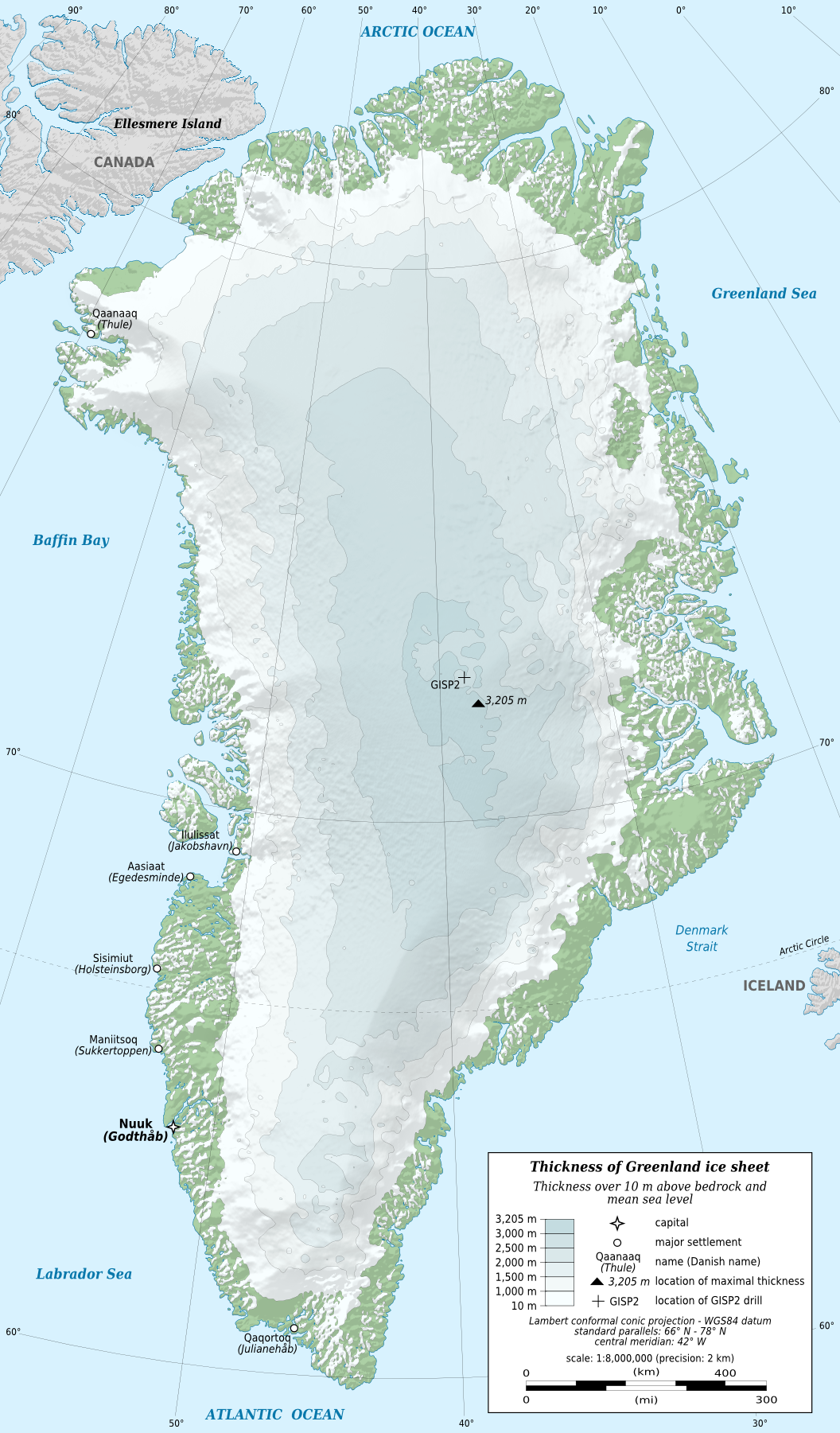
Greenland ice sheet


But what's really fascinating is what scientists have found underneath all that ice. Using special radar technology, they've discovered an amazing landscape with deep valleys and huge mountains. There's even a canyon down there that's as impressive as the Grand Canyon!
Topographic map of Greenland without its ice sheet

Greenland is melting. Every year, about 260 billion tonnes of ice flows into the ocean (https://www.climate.gov/greenland-ice-sheet-melting). That's a lot of ice, and it's melting faster than ever before. If all of Greenland's ice melted - all 2.85 million cubic kilometers of it - our oceans would rise by 7.42 meters (24.34 feet). Just think about what that would mean for coastal cities around the world.

Scientists are keeping a close eye on this melting ice. In the last twenty years, they've noticed it's melting much faster than before. Understanding the landscape under the ice helps them figure out how quickly these changes might happen.

Interested in learning more? Check out these books and maps: (Amazon Associate Links)
I'd love to hear what you think about this hidden landscape! Have you ever seen a glacier up close? Share your stories in the comments!

This post may contain affiliate links. As an Amazon Associate, I earn from qualifying purchases.


Popular posts from this blog

Map of Fox Species Distribution

Foxes are small to medium-sized members of the Canidae family, which also includes wolves, dogs, and other related animals. There are about 37 species of foxes distributed around the world, and they inhabit a wide range of environments, from forests and grasslands to deserts and urban areas. Below is the map of fox species distribution  created by Reddit user isaacSW Here are some of the most well-known fox species and their distribution: Red Fox ( Vulpes vulpes ): The red fox is one of the most widely distributed fox species and is found in North America, Europe, Asia, and parts of North Africa. They are adaptable and can live in a variety of habitats, including forests, grasslands, and urban areas. Arctic Fox ( Vulpes lagopus ): The Arctic fox is found in the Arctic regions of North America, Europe, and Asia. They have adaptations that help them survive in cold climates, such as a thick coat that changes color with the seasons. Gray Fox ( Urocyon cinereoargenteus ): The gray ...

Moose population in North America

The moose ( Alces alces ) is the largest member of the deer family, characterized by its massive size, long legs, and distinctive broad, palmate antlers found in males. They have a dark brown or black coat and a humped shoulder. Moose are primarily found in the boreal and mixed deciduous forests of North America, Europe, and Asia. They are solitary animals, often found near bodies of water, and are herbivores that feed on leaves, bark, twigs, and aquatic vegetation. Despite their size, moose are strong swimmers and can run up to 35 miles per hour. The moose population in North America is shrinking swiftly. This decrease has been correlated to the opening of roadways and landscapes into this animal's north range.   In North America, the moose range includes almost all of Canada and Alaska, the northern part of New England and New York, the upper Rocky Mountains, northern Minnesota and Wisconsin, Michigan's Upper Peninsula, and Isle Royale.    In 2014-2015, the North Americ...

Fallingwater: Where Architecture Meets the Wild

 Located in southwestern Pennsylvania's woods, Fallingwater is not a house, but a powerful conversation between nature and architecture. Completed in 1935 by Frank Lloyd Wright for the Kaufmanns, it's one of the only buildings that truly does seem alive—as if it grew directly out of the rock. What is so revolutionary about Fallingwater isn't its appearance—it's Wright's philosophy of organic architecture: the idea that houses are there to harmonize with nature, not dominate it. The house was actually constructed into the land, resting directly above a waterfall on Bear Run. Instead of looking out over the waterfall, Wright built the waterfall into the house, and the sound of running water is therefore a constant companion. Crafted From the Land, For the Land The materials used to build Fallingwater tell their own story. The stone was quarried on-site. Local craftsmen helped shape every contour. The horizontal lines of the cantilevered terraces echo the layered rock...