
Forests in the world

 According to the FAO, forests cover about 4 million square kilometers (or 15.1 sq mi), about 30 planets of the Earth’s land surface.

Europe accounts for one-fourth of the whole forest area, accompanied by South America and North America among world regions. South America is the continent with the highest forest cover percentage, while Asia is the continent with the lowest rate of forest cover.

Forests at various latitudes and elevations form different biomes: boreal, temperate, tropical forests. VividMaps.com published a world atlas of different forest biomes.

Forests in the world

Map of Needleleaf forests

Needleleaf forests grow mostly in territories that have long, harsh winters. These forests spread over Canada and northern Europe.

Scarce needle-leaf forests grow in some warmer territories. For example, the Southeastern U.S. states have extensive groves of pines, such as Pinus taeda and Pinus palustris.

Need leaf forests

Evergreen broadleaf forests

Evergreen broad-leaved forests grow in the subtropical, tropical, and equatorial territories of our planet.

Evergreen broadleaf forests


Deciduous broadleaf forests

Deciduous broadleaf forests are a type of temperate forest ‘dominated’ by trees that lose their leaves each year. They are growing in regions with mild, humid summers and cold winters.

Deciduous broadleaf forests

Mixed forests

Mixed forests are a vegetational transition within needle leaf forests and broadleaf deciduous forests.

Mixed forests

The number of tree species in the world

According to Roberto Cazzolla Gatti, based on global ground-sourced data, about 73 thousand tree species worldwide, among which 9 thousand tree species are yet to be discovered. Approximately 40 percent of undiscovered tree species are in South America.
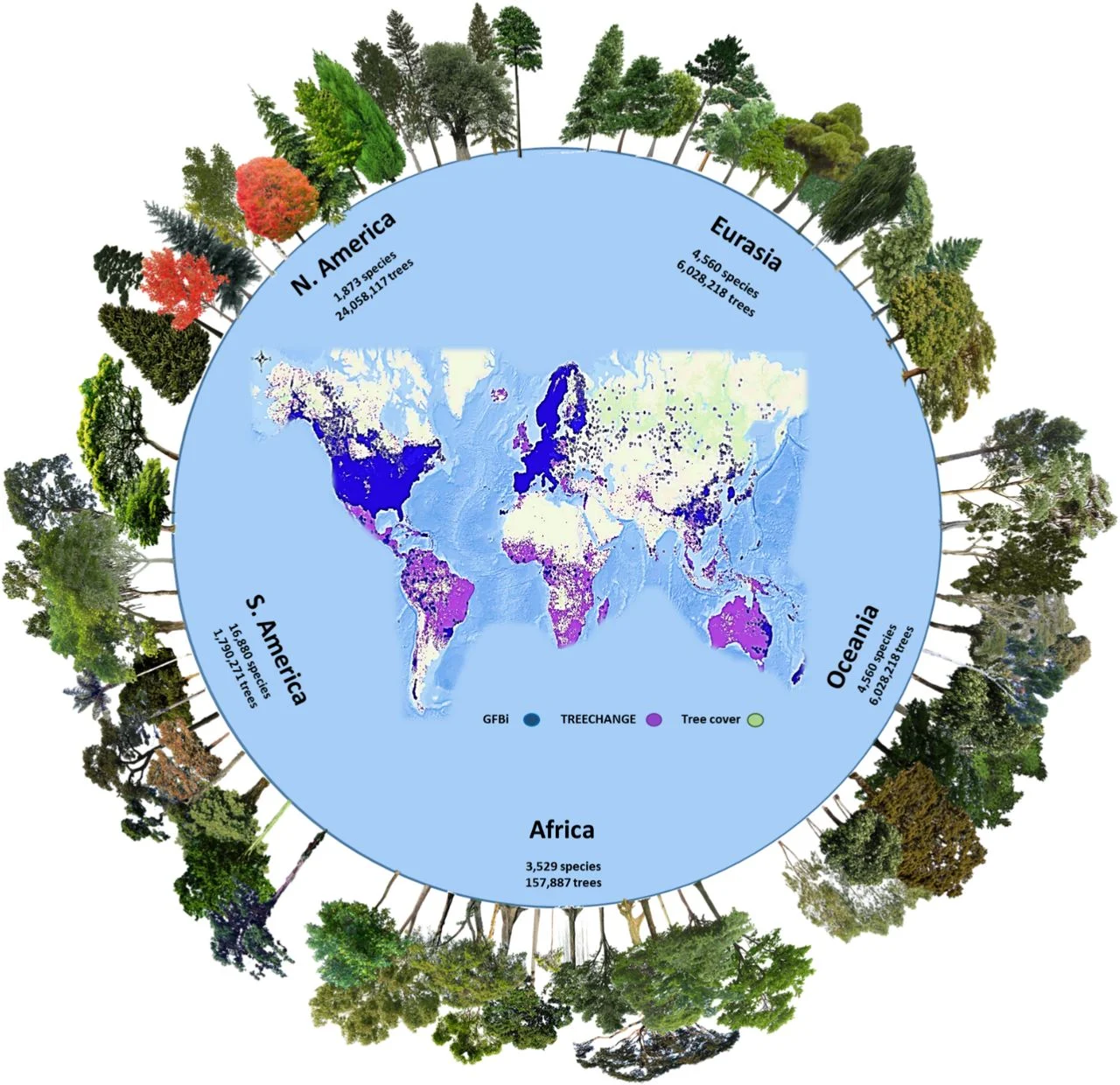
Tree species by countinent

South America accounts for the highest total number of rare species (8,200 species), followed by Eurasia (6,100) and Africa (3,900). 

Moreover, almost 1/3 of all tree species to be discovered may be rare, with low populations and limited spatial distribution mainly in remote mountains and tropical lowlands. 

The map below shows the number of tree species per continent according to the Global Forest Biodiversity Initiative database based on records of about 38 million trees for 28,192 species.
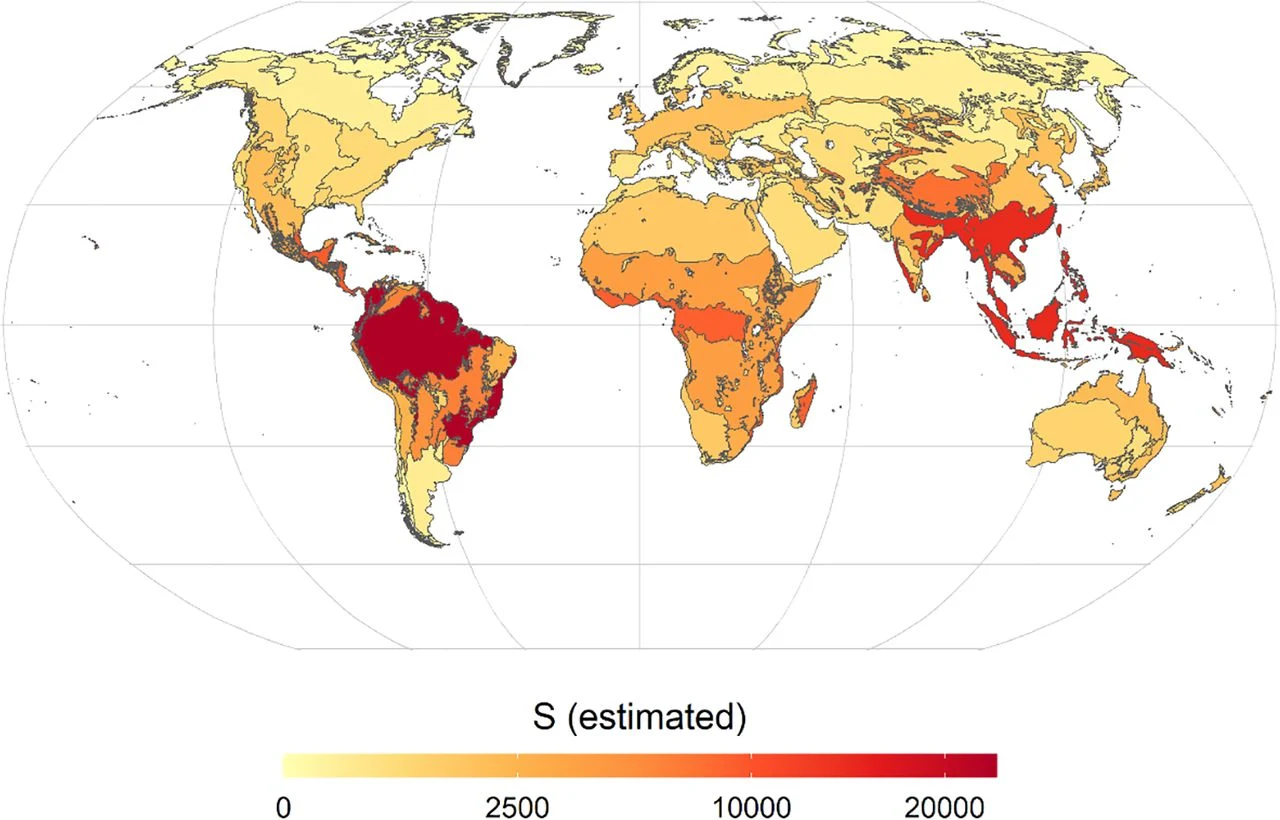
Number of tree species per continent

These findings emphasize the vulnerability of global forest biodiversity to anthropogenic transformations in land use and climate, which especially endanger rare species and, thus, global tree richness.

This post may contain affiliate links. As an Amazon Associate, I earn from qualifying purchases.


Comments

Popular posts from this blog

How Long Does Plastic Take to Decompose?

  Plastic: the unwelcome house guest at nearly every corner of our lives — from shopping bags to footwear, coffee cups to car parts. And yet, discarded, plastic doesn't just evaporate into thin air. No, it lingers. For decades. Even centuries. According to statistics presented by Visual Capitalist , plastic daily consumer goods can break down between 20 and 600 years, depending on the composition used, how they were created, and natural elements like water and sunlight they are exposed to. Let's go deeper into why plastic takes so long to break down — and what horrid messes it leaves behind in the process. Why Plastic Isn't "Natural" — and Why That's a Problem Plastic does not naturally exist. It's a product made from petroleum and natural gas. Its long, tough carbon bonds differ from anything naturally found in ecosystems, making it extremely resistant to microbial breakdown. When we toss a plastic bottle or bag away, it's not a matter of if it will s...

Fallingwater: Where Architecture Meets the Wild

 Located in southwestern Pennsylvania's woods, Fallingwater is not a house, but a powerful conversation between nature and architecture. Completed in 1935 by Frank Lloyd Wright for the Kaufmanns, it's one of the only buildings that truly does seem alive—as if it grew directly out of the rock. What is so revolutionary about Fallingwater isn't its appearance—it's Wright's philosophy of organic architecture: the idea that houses are there to harmonize with nature, not dominate it. The house was actually constructed into the land, resting directly above a waterfall on Bear Run. Instead of looking out over the waterfall, Wright built the waterfall into the house, and the sound of running water is therefore a constant companion. Crafted From the Land, For the Land The materials used to build Fallingwater tell their own story. The stone was quarried on-site. Local craftsmen helped shape every contour. The horizontal lines of the cantilevered terraces echo the layered rock...

Barbie’s Feet Are Getting Flatter—And It Says a Lot About Us

Barbie’s arched feet have long been a part of her image—tiny, pointed, and forever perched for stilettos. But that’s starting to change. A new study reveals that Barbie’s feet are flattening, and that shift isn’t just about doll design—it reflects a broader change in how we think about women’s fashion and comfort. A team of podiatrists at Monash University analyzed 2,750 Barbie dolls produced between 1959 and 2024. They found that while every single doll in the 1960s had permanently arched feet made to fit high heels, only about 40% of Barbies in the 2020s still have that same foot shape. This shift isn’t random. It follows Barbie’s growing list of careers—astronaut, firefighter, doctor—where practical shoes make a lot more sense than stilettos. This change was even acknowledged in the 2023 Barbie movie. In one early scene, Margot Robbie’s Barbie steps out of her heels and her feet stay arched, just like the classic dolls. But later in the film, her feet flatten out, a visual cue ...