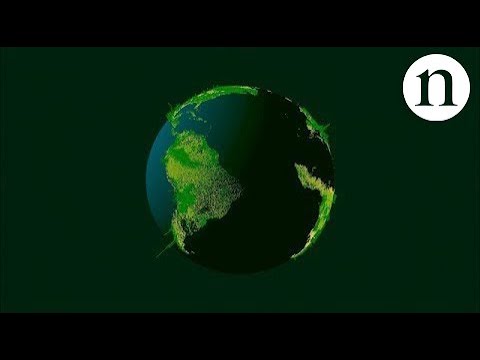
How many trees are there in the world?


It’s a simple question: how many trees are there on Earth? The answer required 421,529 measurements from fifty countries on six continents. Now this new data has been combined to produce a stunning visualisation of our planet as you’ve never seen it before.

The global extent and distribution of forest trees is central to our understanding of the terrestrial biosphere. We provide the first spatially continuous map of forest tree density at a global scale. This map reveals that the global number of trees is approximately 3.04 trillion, an order of magnitude higher than the previous estimate. Of these trees, approximately 1.39 trillion exist in tropical and subtropical forests, with 0.74 trillion in boreal regions and 0.61 trillion in temperate regions. Biome-level trends in tree density demonstrate the importance of climate and topography in controlling local tree densities at finer scales, as well as the overwhelming effect of humans across most of the world. Based on our projected tree densities, we estimate that over 15 billion trees are cut down each year, and the global number of trees has fallen by approximately 46% since the start of human civilization.

This post may contain affiliate links. As an Amazon Associate, I earn from qualifying purchases.


Comments

Popular posts from this blog

How Long Does Plastic Take to Decompose?

  Plastic: the unwelcome house guest at nearly every corner of our lives — from shopping bags to footwear, coffee cups to car parts. And yet, discarded, plastic doesn't just evaporate into thin air. No, it lingers. For decades. Even centuries. According to statistics presented by Visual Capitalist , plastic daily consumer goods can break down between 20 and 600 years, depending on the composition used, how they were created, and natural elements like water and sunlight they are exposed to. Let's go deeper into why plastic takes so long to break down — and what horrid messes it leaves behind in the process. Why Plastic Isn't "Natural" — and Why That's a Problem Plastic does not naturally exist. It's a product made from petroleum and natural gas. Its long, tough carbon bonds differ from anything naturally found in ecosystems, making it extremely resistant to microbial breakdown. When we toss a plastic bottle or bag away, it's not a matter of if it will s...

Fallingwater: Where Architecture Meets the Wild

 Located in southwestern Pennsylvania's woods, Fallingwater is not a house, but a powerful conversation between nature and architecture. Completed in 1935 by Frank Lloyd Wright for the Kaufmanns, it's one of the only buildings that truly does seem alive—as if it grew directly out of the rock. What is so revolutionary about Fallingwater isn't its appearance—it's Wright's philosophy of organic architecture: the idea that houses are there to harmonize with nature, not dominate it. The house was actually constructed into the land, resting directly above a waterfall on Bear Run. Instead of looking out over the waterfall, Wright built the waterfall into the house, and the sound of running water is therefore a constant companion. Crafted From the Land, For the Land The materials used to build Fallingwater tell their own story. The stone was quarried on-site. Local craftsmen helped shape every contour. The horizontal lines of the cantilevered terraces echo the layered rock...

Barbie’s Feet Are Getting Flatter—And It Says a Lot About Us

Barbie’s arched feet have long been a part of her image—tiny, pointed, and forever perched for stilettos. But that’s starting to change. A new study reveals that Barbie’s feet are flattening, and that shift isn’t just about doll design—it reflects a broader change in how we think about women’s fashion and comfort. A team of podiatrists at Monash University analyzed 2,750 Barbie dolls produced between 1959 and 2024. They found that while every single doll in the 1960s had permanently arched feet made to fit high heels, only about 40% of Barbies in the 2020s still have that same foot shape. This shift isn’t random. It follows Barbie’s growing list of careers—astronaut, firefighter, doctor—where practical shoes make a lot more sense than stilettos. This change was even acknowledged in the 2023 Barbie movie. In one early scene, Margot Robbie’s Barbie steps out of her heels and her feet stay arched, just like the classic dolls. But later in the film, her feet flatten out, a visual cue ...